Our Sustainability Vision
A recovery chain designed to be cleaner at every stage — not just at the end of it.
ALTIM RE isn't adding sustainability to a conventional recycling operation. From the route material travels to the power that runs our hub, the environmental case is built into the model from day one — a standard we hold ourselves to, not a claim we make once and move on from.
Our path to zero emissions
How we get there.
A logistics chain already engineered to cut emissions.
Blade sections are cut on-site, then moved by truck to a rail hub. From there they travel by train — the single longest leg of the journey — before completing the final distance by truck. That routing choice matters: European Environment Agency data puts rail freight at roughly 17.4g CO2 per tonne-km, against roughly 46.9g for road transport — rail produces close to two and a half times less CO2 than the equivalent truck journey. It's exactly why the EU's Transport 2050 Strategy calls for shifting a growing share of long-distance road freight onto rail. By routing our longest leg through rail, we're following where European transport policy is already steering the logistics industry.
Retiring diesel from what remains of the road.
The truck legs that bookend the rail journey are what we're actively working to electrify. Heavy-duty electric trucks are a real, commercially operating category today on European regional and cross-border routes, supported by an expanding fast-charging network. Battery-electric heavy trucks already produce meaningfully lower lifecycle emissions than diesel equivalents — a gap that keeps widening as European grids keep decarbonizing. We intend to be inside that curve, not watching it from outside.
A processing hub that generates its own power.
Our facility's steam generation — currently dependent on fossil fuel, like virtually every comparable processing plant — is our next target. Electric steam generation is mature, commercially available technology already used across food processing, pharmaceutical and industrial manufacturing worldwide. The economics flip decisively in favor once a facility generates its own renewable power on-site — exactly our plan, powering our own hub with the same wind and solar infrastructure knowledge at the center of our business.
A recovery chain where the trucks run on electricity, the long-haul leg runs on rail, and the plant runs on the same renewable power sources it was built to recycle — a genuinely end-to-end, zero-emission operation. Not a claim. A design.
Environmental impact, by the numbers
Why this matters at a European scale.
Every figure below is traced to a named public source — WindEurope, the European Environment Agency, or peer-reviewed EU research. No projections, no rounding in our favor.
Transport
Emissions avoided by routing through rail
Solar recycling
The capacity gap we're built to close
Wind · Diverted from landfill
What a recovered blade breaks down into
Solar · Diverted from landfill
What a recovered panel breaks down into
Circular economy positioning
Built for a regulatory shift that's already underway.
Regulation is closing the old pathway
The EU's blade landfill ban is already in force, and the WEEE Directive already mandates collection and recycling of end-of-life PV modules. Both frameworks point the same direction: material that used to go to landfill now needs a documented, compliant recovery pathway. ALTIM RE exists to be that pathway — for wind and solar alike — rather than a workaround for it.
Recovered material re-enters real supply chains
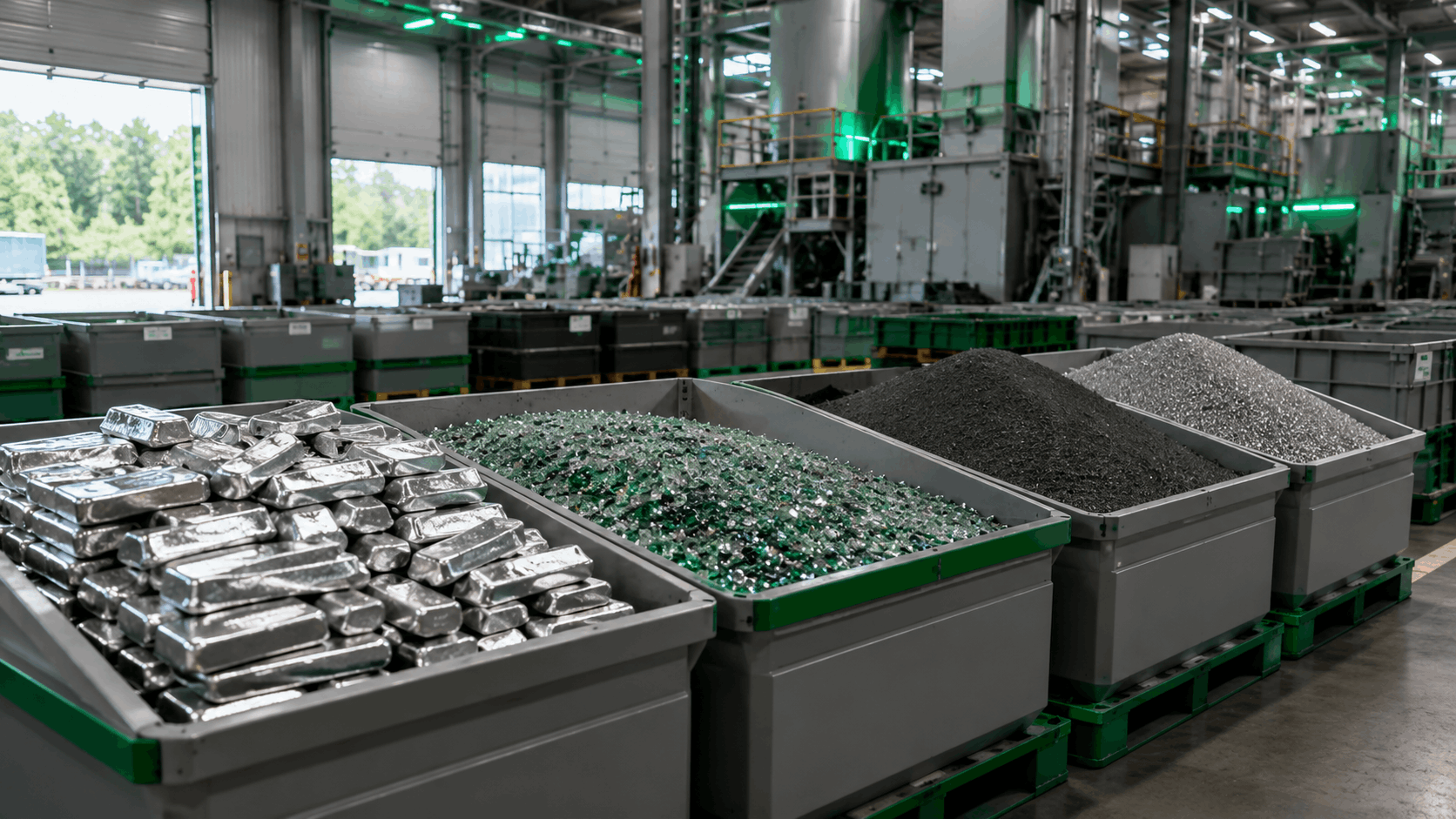
Fiberglass, resin and steel from blades feed cement, composites, insulation and industrial filler production. Glass, aluminium, silicon and metals from panels return to construction, electronics and manufacturing. This isn't disposal — it's material moving back into use.
Two waste streams, one regional hub
Wind blades and solar panels are fundamentally different materials, but the underlying problem — large volumes of end-of-life renewable-energy equipment with no dedicated regional pathway — is the same. Building dual-stream capability from the start means the environmental case scales with both industries, not just one.
Partnerships